


.webp)


Valley Air Conditioning Guide: Troubleshooting Your First Fall Furnace Startup
Why your heater smells like burning dust. Review these home maintenance tips and troubleshooting steps to know what is normal and when to call a professional.
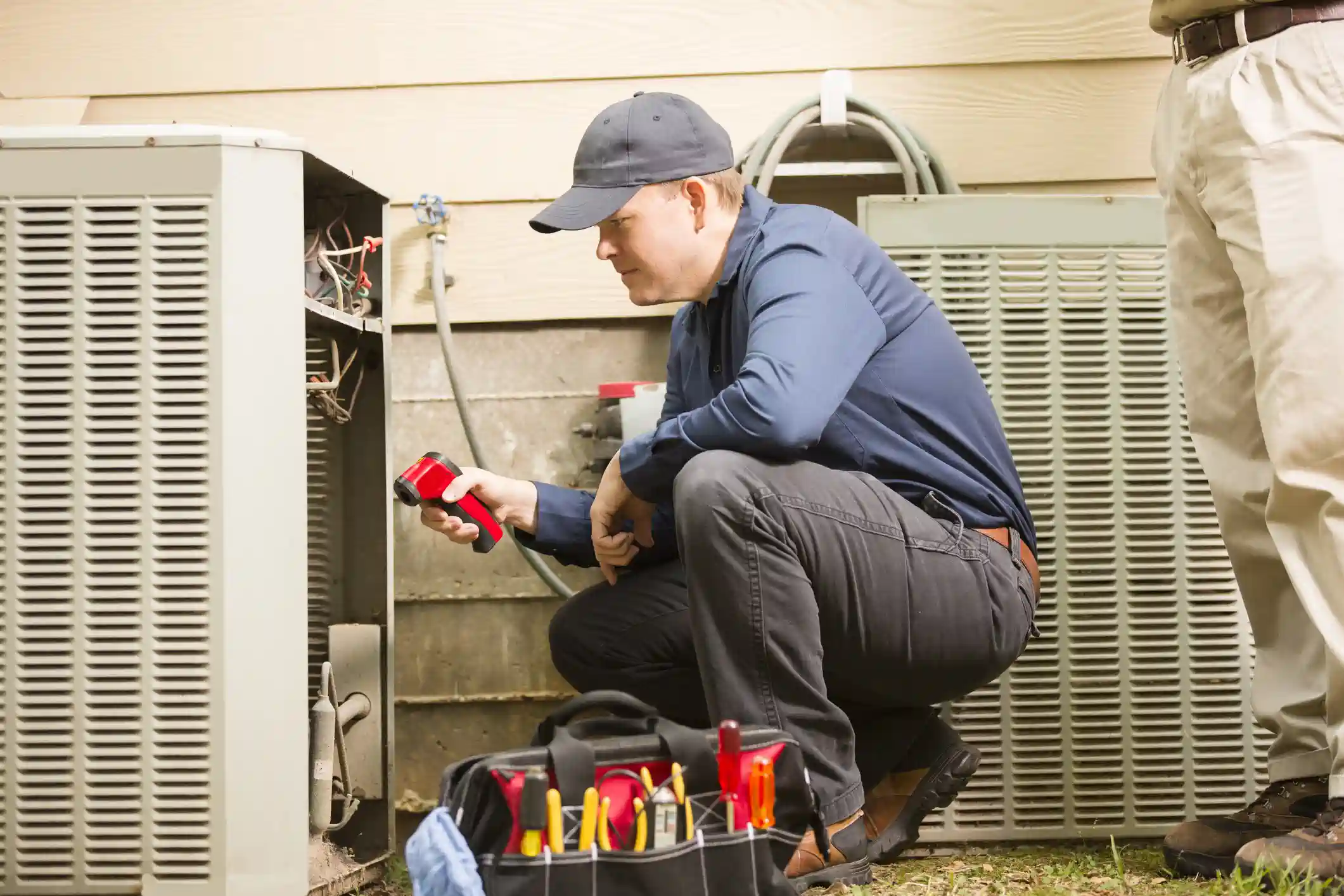
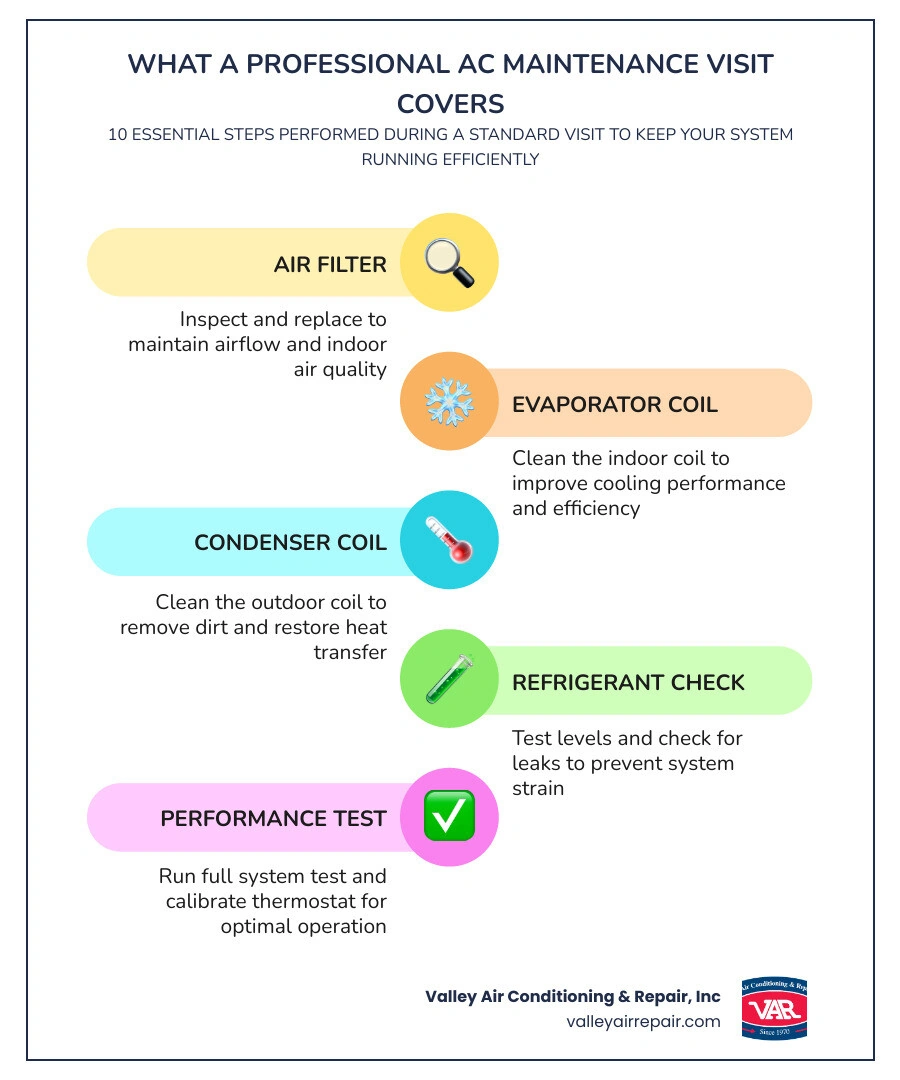
What does an AC maintenance visit include is one of the most common questions homeowners ask before scheduling service — and it's a smart one. Here's a quick answer:
A standard AC maintenance visit typically includes:
Most visits take between 60 and 90 minutes for a properly maintained system.
Heating and cooling account for roughly 52% of a typical household's annual energy use. That means your AC isn't just a comfort tool — it's one of the biggest drivers of your monthly utility bill. And here in California's Central Valley, where summer temperatures routinely push into triple digits, a system that hasn't been serviced can mean more than higher bills. It can mean a breakdown on the hottest day of the year.
The good news is that most AC problems don't appear out of nowhere. They build slowly — a worn capacitor here, a clogged drain line there — until something fails. A professional maintenance visit is designed to catch those small issues before they become expensive emergencies. Regular maintenance can also reduce power consumption by up to 15% and extend your system's lifespan by several years.
At Valley Air Conditioning & Repair, Inc., we've been helping Central Valley homeowners stay cool and comfortable since 1970. This guide walks you through exactly what happens during a professional AC maintenance visit, step by step.
Living in the Central Valley means our air conditioners work incredibly hard. During our long, scorching summers, a cooling system can run for thousands of hours. Just like a car that needs regular oil changes and tire rotations to keep running smoothly, your home's cooling system requires consistent attention to perform at its best.
When you prioritize Preventative AC Maintenance, you are directly investing in the health and longevity of your home. A well-maintained AC system typically lasts between 12 and 15 years. However, completely skipping this routine upkeep can shorten that lifespan by 3 to 5 years. Without professional care, the physical wear and tear of our dusty Valley summers will quickly take a toll on delicate internal components.
Efficiency is another major factor. Over time, dust, dirt, and outdoor debris settle on your system’s coils and fans. This layer of grime acts as an insulator, making it much harder for your AC to release heat. In fact, simple airflow problems can reduce your system's overall efficiency by up to 15%. When your system has to work harder to cool your home, it draws more power, which directly inflates your utility bills.
Additionally, we must consider the air we breathe. The Environmental Protection Agency (EPA) notes that indoor pollutant levels are often 2 to 5 times higher than outdoor levels. In a dusty agricultural region like ours, keeping your system clean is vital for your family's respiratory health. Routine service ensures that your system filters out allergens, pollen, and dust effectively, rather than continuously blowing them back into your living spaces.
Finally, did you know that up to 20% to 30% of conditioned air in a typical home is lost through duct leaks? During a maintenance visit, a trained technician can spot these hidden issues, helping you keep your cool air where it belongs — inside your home.
When you schedule professional service, the technician doesn’t just walk in, change a filter, and leave. A true, high-quality AC Maintenance visit is a comprehensive, multi-point inspection of your entire home comfort system. It is designed to evaluate electrical safety, mechanical calibration, and thermodynamic efficiency.
Think of it as a complete physical for your air conditioner. The technician will systematically move through your home, checking both the indoor air handler and the outdoor condenser unit. They will measure electrical currents, test safety controls, clean vital components, and ensure that every single part is operating within the manufacturer's original specifications.
By the time the visit is complete, you will have a clear, documented picture of your system's overall health and performance. Let's break down exactly what this process looks like, starting with the work done inside your home.
The indoor portion of your air conditioner is responsible for absorbing heat from your indoor air and moving it outside. Because this unit is housed inside your home — often in a closet, attic, or garage — it directly impacts your indoor air quality and comfort.
During the indoor phase of the visit, your technician will focus on several critical tasks:
To get a complete picture of what to look for, you can review our comprehensive AC Tune-Up Checklist.
Once the indoor components are verified, the technician will move outside to the condenser unit. This is where the heat absorbed from your home is released into the outdoor air. Because it is exposed to the elements year-round, the outdoor unit bears the brunt of Central Valley dust, wind, and heat.
Here is what your technician will check outside:
For a deeper dive into seasonal outdoor preparation, read our guide on What Your Technician Should Check During a Spring AC Visit.
Many homeowners wonder if they can simply wait until something breaks to call for service. While this "reactive" approach might seem convenient, it is almost always more stressful and costly in the long run.
Proactive maintenance is all about prevention. By catching a weak capacitor or a slow refrigerant leak in the spring, you avoid a complete system shutdown in the middle of a July heatwave. Furthermore, skipping your annual service can have serious legal and financial consequences for your equipment: most major HVAC manufacturers require documented proof of annual professional maintenance to keep your parts warranty valid.
To understand how proactive care keeps your home comfortable while keeping your utility bills manageable, check out our resource on How a Tune-Up Improves Efficiency and Lowers Bills.
Here is a quick look at how proactive maintenance compares to reactive repairs:
| Feature | Proactive Maintenance | Reactive Repairs |
|---|---|---|
| Scheduling | Planned ahead at your convenience | Sudden emergency, often during peak heat |
| System Efficiency | Optimizes energy use, lowering bills | System runs poorly, raising utility costs |
| Equipment Lifespan | Extends system life to 12–15+ years | Shortens lifespan by 3–5 years due to strain |
| Warranty Status | Keeps manufacturer warranties valid | Risk of voiding manufacturer parts warranty |
| Stress Level | Low — peace of mind all summer long | High — dealing with a hot house and unexpected repairs |
While a professional maintenance visit is essential, there are several simple things you can do between our visits to keep your system running smoothly. Consistent homeowner care is the perfect complement to professional service.
To make regular maintenance completely hassle-free, consider signing up for our structured Maintenance Plan to receive automatic reminders and priority service.
We understand that you want to make the best decisions for your home and family. Here are some of the most common questions our customers ask about air conditioning maintenance.
You should schedule a professional AC maintenance visit once per year. The absolute best time to schedule this is in the early spring (March or April) before the summer heat arrives. This ensures your system is clean, fully charged, and ready to handle the intense summer workload. If you use a heat pump system that provides both heating and cooling, we recommend scheduling bi-annual visits — once in the spring for cooling, and once in the fall for heating.
For a standard residential system that has been regularly maintained, a thorough maintenance visit typically takes between 60 and 90 minutes. This gives our technician plenty of time to run a full performance test, clean the coils, flush the drain line, and carefully inspect all electrical connections. If your system is older, has multiple zones, or has not been serviced in several years, the visit may take closer to two hours.
If your system is showing any of the following warning signs, do not wait for your annual appointment — schedule a visit right away:
Your air conditioner is a major investment in your family's comfort, health, and daily peace of mind. Knowing what does an AC maintenance visit include empowers you to make informed decisions and ensure your system gets the high-quality care it deserves before our intense California summers begin.
Since 1970, Valley Air Conditioning & Repair, Inc. has built its reputation on a customer-first philosophy, honorable intentions, and honest, word-of-mouth growth. We treat your home and your family with the respect you deserve, ensuring you stay comfortable all year long.
If your cooling system is due for its annual tune-up, we are here to help. We proudly serve homeowners throughout the Central Valley, including Biola, Clovis, Coarsegold, Del Rey, Dinuba, Fowler, Fresno, Friant, Kerman, Kingsburg, Laton, Lemoore, Madera Ranchos, Madera, O’Neals, Parlier, Reedley, Riverdale, Sanger, Selma, and Yosemite Lakes.
Ready to secure your home's comfort and efficiency for the upcoming season? Contact us today to schedule your professional AC Maintenance Fresno CA visit, or book your seasonal service in your local community:

As a business with many AC units, it is essential to have a responsive AC company. Valley Air Conditioning understands our needs. They are always responsive and our AC is up and running very quickly.
I had them do an AC check on the home I was buying, they were honest and quick. I hired them to do the summer and Fall maintenance for $149. Happy with this company!
100% recommend. I called, same day they came out and gave me estimate. Conley was honest and didn't try to recommend/sell us anything we didn't need. When I called him with questions before making a decision, he happily answered and was not annoyed by me contacting him. Conley and VAR
This is a group of good people. Very professional and knowledgeable. They take the time to listen and find the best solution that fits best for any situation. There's no way you can go wrong in choosing VAR.
We have used Valley Air for over fifteen years. The last two years ,Matt came to our house to service twice a year. Always on time, so polite and so professional. This is a very honest company and you can always depend on them and trust them. The office always treats everyone cheerfully and always want to do what you need done very fast YOU CAN COUNT ON THIS Company


