.webp)



Valley Air Conditioning's Guide to Fall Furnace Startups: Normal Symptoms vs. Warning Signs
Why we prioritize safety during fall heating startups. Rely on these home maintenance tips and troubleshooting to tell normal dust odors from warning signs.
If you want to know how to extend the life of your AC in Arizona or other scorching climates like California's Central Valley, here are the most important steps to take right now:
In the Central Valley, your air conditioner isn't a seasonal convenience — it's a year-round necessity. While some parts of the country can give their AC a rest, homeowners in our region run their systems nearly around the clock from late spring through early fall. That relentless workload takes a real toll.
Here's the core problem: AC units in hot climates typically last just 10 to 15 years, compared to the national average of 15 to 20 years. Some systems fail even sooner — as early as 8 to 10 years — when maintenance is skipped. The combination of temperatures that regularly exceed 100°F, dusty valley air, and cooling seasons that stretch from April through October puts extreme stress on every component inside your system.
The good news is that how long your AC lasts isn't entirely out of your hands. The right habits and maintenance routine can add years to your system's life — and keep your energy bills from spiraling every summer.
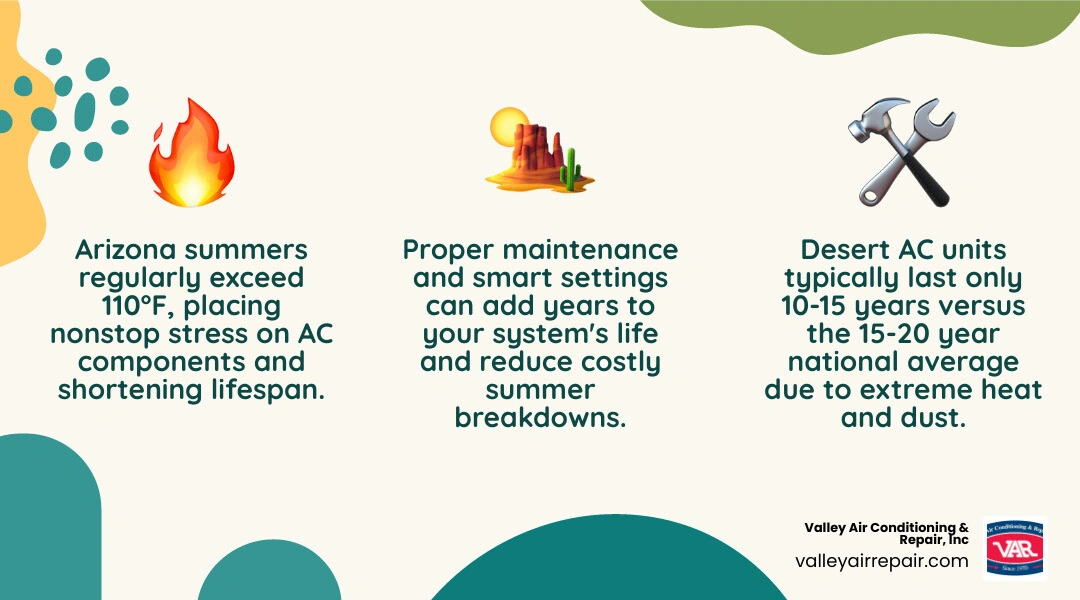
When we talk about air conditioning longevity, geography is everything. In milder climates across the United States, an air conditioner is a part-time worker. It sits idle for most of the winter, spring, and fall, only turning on during the humid mid-summer months. Under those gentle conditions, a standard central air system can easily coast to a 15-to-20-year lifespan.
Now, contrast that with life in the Central Valley. Here, our cooling season begins in April and often stretches deep into October. During the peak of July and August, outdoor temperatures regularly push past triple digits, forcing your air conditioner to run anywhere from 12 to 18 hours a day.
In terms of pure run hours, a local AC unit logs between 2,000 and 3,000 cooling hours annually. Compare that to the national average of just 750 to 1,000 hours per year. A 10-year-old air conditioner in our region has done the mechanical equivalent of a 25-year-old unit in the Midwest!
This relentless demand explains why local systems typically max out at 10 to 15 years. When the thermometer hits those triple digits, your system has to work 30% to 40% harder just to reject heat from your home. To understand why your system runs so hard during these grueling stretches, check out our guide on Why Your AC Runs Constantly in Arizona Heat.
Because our hot climate acts as a year-round gauntlet for mechanical equipment, proactive care isn't just a good idea—it is a vital survival strategy for your comfort. A significant portion of your home's summer energy consumption goes directly toward keeping your living space cool.
Preventative care is the most effective tool you have to combat high energy usage and keep your system running for its full intended lifespan. When you neglect basic maintenance, system efficiency drops by up to 15%, forcing the compressor to run longer and hotter to deliver the same amount of cool air.
To protect your investment, you must adapt your maintenance habits to the local environment. For a deep dive into how our unique geography impacts your system, explore our detailed look at Proper HVAC Maintenance for Desert Climate.
One of the easiest ways to extend your system's lifespan costs absolutely nothing: adjusting your thermostat habits.
Many homeowners believe that setting the thermostat to 70°F on a 105°F day will cool the house down faster. In reality, your AC blows air at the same temperature regardless of the setting—it simply runs longer to reach lower targets. Pushing your system to maintain a massive temperature difference between the indoors and outdoors leads to "heat-soak," where your walls, ceilings, and furniture absorb extreme heat, making it nearly impossible for the AC to cycle off.
Instead, follow these smart operational habits:
By scheduling a seasonal checkup early in the year, you can ensure your system is calibrated to handle these adjustments. Learn more about how How Spring Maintenance Prevents Breakdowns in Extreme Heat.
While DIY habits are highly beneficial, they cannot replace the specialized tools and expertise of a professional technician. Think of your AC like a high-performance car; you can wash it and check the oil, but you still need a mechanic to tune the engine.
During a professional tune-up, a technician focuses on several critical areas that directly impact system longevity:
Extreme summer heat is brutal on electrical systems. The temperature inside your outdoor unit's electrical cabinet can easily reach 170°F. This extreme environment causes capacitors—the small cylindrical parts that store and release start-up energy—to degrade rapidly. A weak capacitor forces the compressor and fan motors to draw excessive amperage, leading to premature motor burnout. Technicians test these components to catch failing parts before they cause a total system breakdown.
Your air conditioner relies on a precise charge of refrigerant to transfer heat out of your home. Even a minor 10% undercharge can cause a 20% loss in operating efficiency and make the compressor run dangerously hot. Technicians check for microscopic leaks and ensure your refrigerant levels are perfectly balanced.
Over the course of a windy spring, fine dust and pollen settle deep into your outdoor condenser coils. This buildup acts as a thermal blanket, trapping heat inside the unit and forcing the compressor to work twice as hard. A professional cleaning restores proper heat transfer, instantly lowering system strain.
To make sure your system gets a comprehensive inspection, review our AC Tune-Up Checklist: What Your Technician Should Check.
Taking care of your air conditioner is a partnership between you and your professional service provider. By performing a few simple tasks at home, you keep your system in peak condition between our visits.
Here are the most impactful steps you can take on your own:
To help you organize your seasonal chores, we have put together this comparison table of homeowner tasks versus professional services:
| Homeowner Maintenance Tasks (Monthly/As Needed) | Professional Tune-Up Services (Annual/Bi-Annual) |
|---|---|
| Inspect air filters every 30 days and replace when dirty | Measure electrical amperage draw and test capacitor health |
| Clear weeds, leaves, and debris within 2 feet of the outdoor unit | Check and adjust refrigerant levels to manufacturer specs |
| Flush the condensate drain line with vinegar | Clean and chemically wash indoor and outdoor coils |
| Keep indoor supply and return vents open and unblocked | Inspect, tighten, and lubricate all moving parts |
| Hose down outdoor condenser coils gently with low pressure | Calibrate the thermostat and inspect safety controls |
To learn more about setting up a regular schedule for these tasks, read our guide on Preventative AC Maintenance.
Even with meticulous maintenance, every air conditioner eventually reaches the end of its useful life. In our demanding climate, components wear out, and older systems become increasingly inefficient to run.
So, how do you know when it is time to stop repairing your old unit and invest in a replacement?
If you are facing this decision right now, we have resources to help you weigh your options. Check out our articles on Should You Repair or Replace Your AC and Is It Worth Fixing an Old AC Unit in the Desert.
On average, a well-maintained air conditioner in these demanding climates lasts between 10 and 15 years. Without regular professional maintenance and monthly filter changes, a system can fail in as little as 8 to 10 years due to the extreme heat and heavy dust.
Yes, but only if done correctly. Providing shade with trees, a trellis, or an awning can lower the surrounding air temperature by up to 10°F, improving operating efficiency by up to 10%. However, you must never build a tight enclosure or place a solid cover directly over the unit. This traps the hot exhaust air, forcing the system to recycle its own heat and causing the compressor to overheat.
You should check your air filters every 30 days during the peak summer months. If you have pets, allergies, or live in an area prone to dust storms, you will likely need to replace them monthly. During the milder winter months, you can transition to replacing them every 60 to 90 days.
Extending the life of your air conditioner in our demanding climate requires a mix of smart daily habits and consistent, professional care. By keeping your filters clean, optimizing your thermostat, and ensuring your outdoor unit has plenty of room to breathe, you can protect your system from premature wear and keep your home comfortable all summer long.
At Valley Air Conditioning & Repair, Inc., we have been serving "the Valley" with a customer-first philosophy built on trust, honorable intentions, and reliable service since 1970. Whether you live in Biola, Clovis, Coarsegold, Del Rey, Dinuba, Fowler, Fresno, Friant, Kerman, Kingsburg, Laton, Lemoore, Madera Ranchos, Madera, O’Neals, Parlier, Reedley, Riverdale, Sanger, Selma, or Yosemite Lakes, our team is here to help you get the most out of your cooling system.
Ready to protect your comfort and extend your system's lifespan? Schedule your seasonal service today by visiting our guide on Proper HVAC Maintenance for Desert Climate.

As a business with many AC units, it is essential to have a responsive AC company. Valley Air Conditioning understands our needs. They are always responsive and our AC is up and running very quickly.
I had them do an AC check on the home I was buying, they were honest and quick. I hired them to do the summer and Fall maintenance for $149. Happy with this company!
100% recommend. I called, same day they came out and gave me estimate. Conley was honest and didn't try to recommend/sell us anything we didn't need. When I called him with questions before making a decision, he happily answered and was not annoyed by me contacting him. Conley and VAR
This is a group of good people. Very professional and knowledgeable. They take the time to listen and find the best solution that fits best for any situation. There's no way you can go wrong in choosing VAR.
We have used Valley Air for over fifteen years. The last two years ,Matt came to our house to service twice a year. Always on time, so polite and so professional. This is a very honest company and you can always depend on them and trust them. The office always treats everyone cheerfully and always want to do what you need done very fast YOU CAN COUNT ON THIS Company