.webp)


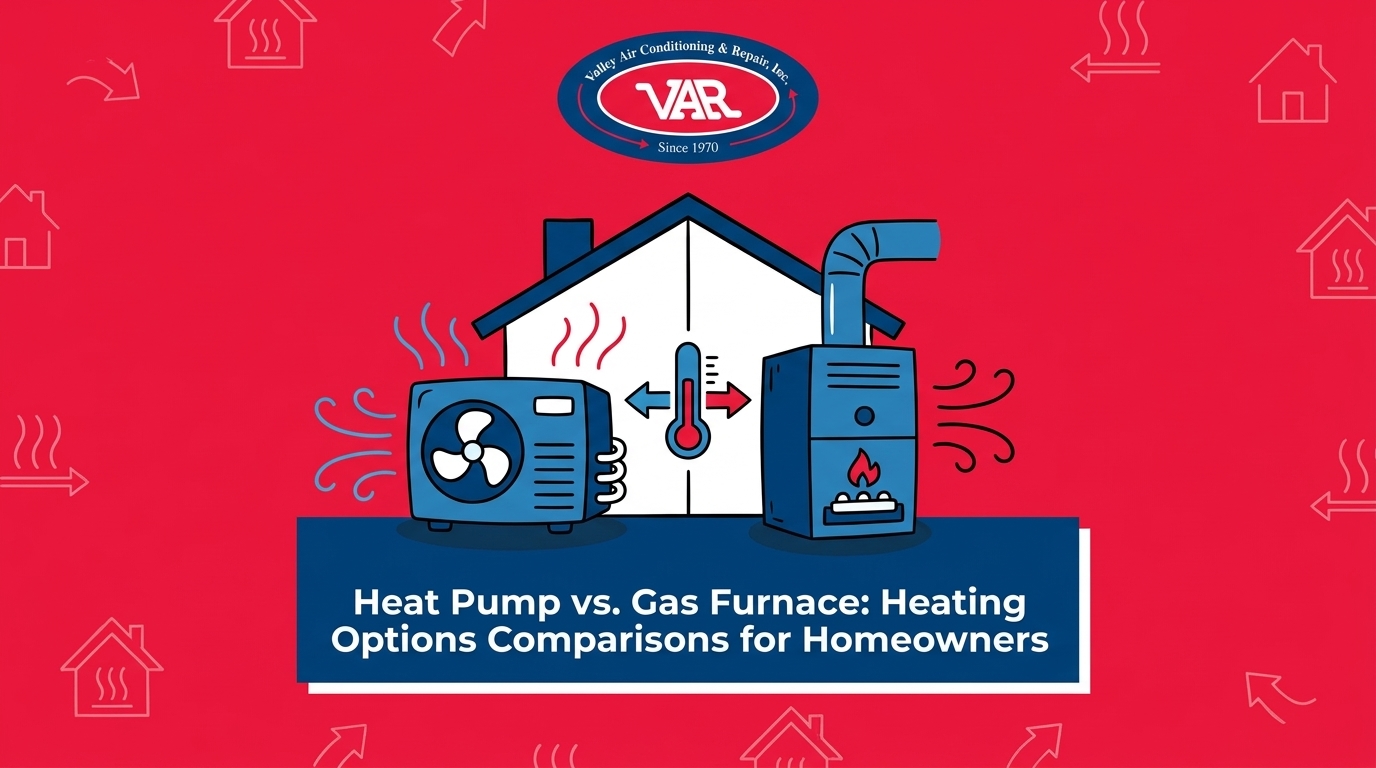
Heat Pump vs. Gas Furnace: Heating Options Comparisons for Homeowners
Deciding between a heat pump and gas furnace this fall? See our options comparisons for homeowners to evaluate winter performance. Compare your options today.
How does a heat pump work in a desert climate is one of the most practical questions a homeowner in California's Central Valley can ask. If you want the short answer:
Desert homeowners in places like Fresno, Modesto, and the broader Central Valley know the challenge well. Summers push temperatures well past 100°F for weeks at a time, and while winters are mild, those cool nights can catch you off guard. Finding one system that handles both extremes reliably — without sending your energy bill through the roof — is exactly what most families here are looking for.
The good news is that the desert climate is actually one of the best environments for a heat pump to thrive. Mild winters mean the system rarely has to work as hard as it would in a colder state, and modern technology has made today's units far better equipped for extreme summer heat than older models ever were. Many Arizona and California desert homeowners are already seeing 20-40% reductions in their total annual energy costs after making the switch.
In this guide, we'll walk you through exactly how these systems work, what makes them well-suited (or challenging) for arid conditions, what efficiency ratings to look for, and how to keep your unit running at its best in a dusty, sun-baked environment.
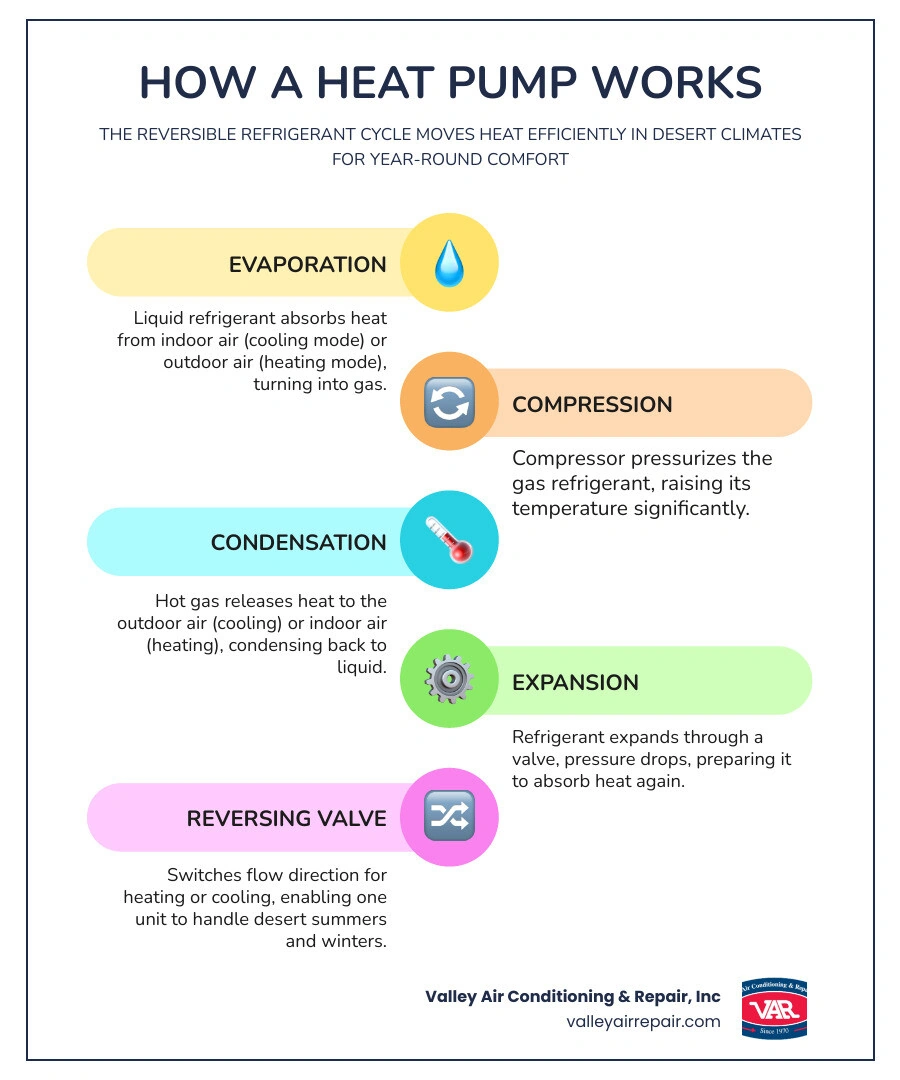
At its core, a Heat Pump is a heat transporter. Unlike a furnace that burns natural gas or uses electric coils to create heat, a heat pump uses electricity to move heat from one place to another. This is achieved through a closed-loop refrigerant cycle.
The magic happens thanks to four main components: the evaporator, the compressor, the condenser, and the expansion valve. However, the "brain" of the operation for a desert climate is the reversing valve. This component allows the system to change the direction of the refrigerant flow, essentially turning your air conditioner into a heater and vice versa.
In our region, whether you are in Biola, Clovis, or Kerman, the process remains the same. The refrigerant absorbs heat at a low temperature and pressure and releases it at a higher temperature and pressure. Because it is moving existing thermal energy rather than creating it, the system can achieve efficiencies of over 300%. This means for every one unit of electricity used, the system can move three to four units of heat.
During our scorching Central Valley summers, a heat pump functions exactly like a high-efficiency air conditioner. Inside your home, the indoor coil (acting as an evaporator) contains cold, liquid refrigerant. As warm air from your living room is blown over this coil, the refrigerant absorbs the heat, causing it to evaporate into a gas.
This heat-laden gas is then sent to the outdoor unit. The compressor increases the pressure of the gas, raising its temperature even further. As it passes through the outdoor condenser coil, a fan blows outside air over the coil to dissipate the heat. In a desert climate, this is where high-quality Heat Pump Service Fresno CA becomes vital. If the outdoor coils are clogged with dust or the refrigerant levels are off, the system cannot release that heat efficiently, leading to higher bills and less comfort.
When the sun goes down in places like Reedley or Dinuba, desert temperatures can drop rapidly. This is where a Heat Pump Reedley CA truly shines. The reversing valve flips the flow of the refrigerant. Now, the outdoor coil acts as the evaporator, extracting ambient warmth from the outside air—yes, even when it feels "cold" outside, there is still plenty of heat energy available in 40°F or 50°F air.
Because desert winters are typically mild and rarely stay below freezing for long periods, heat pumps operate in their "peak efficiency zone" for almost the entire heating season. They provide a gentler, more consistent warmth compared to the "blast" of a gas furnace, which can often lead to uncomfortable temperature swings and overly dry indoor air.
One common misconception is that heat pumps struggle once the mercury hits triple digits. While older, single-stage units might have had difficulty, May 2026 technology has changed the game. The secret lies in variable-speed compressors and inverter technology.
Traditional systems are either "all on" or "all off"—like a gas pedal being stomped to the floor and then released. Inverter-driven heat pumps, however, act like cruise control. They can modulate their output to match the exact cooling needs of your home. When it is 115°F in Kerman, these systems don't just cycle on and off; they run at the precise speed needed to maintain a steady temperature.
If your system is struggling, it may require Heat Pump Repair Kerman CA to check for thermal stress. However, a properly sized, modern unit is rated to maintain full cooling capacity even at temperatures reaching 118°F to 122°F.
| Feature | Heat Pump (Inverter-Driven) | Traditional HVAC (AC + Gas Furnace) |
|---|---|---|
| Cooling Efficiency | Up to 20+ SEER2 | Typically 14-16 SEER2 |
| Heating Efficiency | 300% - 400% (HSPF2 9+) | 80% - 98% (AFUE) |
| Energy Source | All-Electric | Electric + Natural Gas/Propane |
| Performance at 110°F+ | High (with variable speed) | Standard |
| Maintenance | One integrated system | Two separate systems |
Living in the Valley means dealing with unique environmental stressors. Dust storms, intense UV radiation, and incredibly low humidity can all impact how your system performs.
Dust and Sand:Dust is the silent killer of HVAC efficiency. In places like Laton or Riverdale, agricultural dust can quickly coat outdoor coils, acting as an insulator that prevents heat from escaping. This forces the compressor to work harder and can lead to premature failure. Following Proper HVAC Maintenance for Desert Climate protocols—such as semi-annual coil cleanings—is essential.
UV Radiation:The desert sun is brutal on equipment. Budget units often use plastic components that become brittle and crack within 5-7 years. High-end heat pumps designed for the desert feature powder-coated metal cabinets and UV-resistant wiring insulation to withstand the intense California sun.
Low Humidity:While low humidity makes the heat more bearable for us, it can make indoor air feel "thin" and dry out your skin and sinuses. Because heat pumps naturally dehumidify while cooling (just like an AC), they can sometimes make a dry home feel even drier. To counter this, many homeowners opt for Mini Split Repair Laton CA or central system upgrades that include integrated whole-home humidifiers. This allows you to maintain the perfect 40-50% humidity level for maximum comfort.
When shopping for a system in the Central Valley, pay close attention to the SEER2 (Seasonal Energy Efficiency Ratio) and HSPF2 (Heating Seasonal Performance Factor) ratings. For our climate, we recommend looking for a SEER2 of at least 18-20.
If you are considering a Heat Pump Installation in Madera CA, there has never been a better time. As of May 2026, significant financial incentives are available to help offset the investment:
Whether you need a Heat Pump Installation Sanger CA or a system for your home in Madera Ranchos, these incentives make the transition to high-efficiency technology much more accessible.
Yes. Modern, high-efficiency heat pumps with inverter-driven compressors are specifically engineered to operate in extreme heat. While older technology might have seen a drop in capacity, 2026 models are designed to maintain comfort even during the peak of a Central Valley heatwave.
Absolutely. Heat pumps are actually at their most efficient during mild desert winters. Since temperatures in our region rarely stay below freezing for long, the system can easily extract enough heat from the outdoor air to keep your home cozy without the need for supplemental "emergency" heat.
In a dusty desert climate, we recommend checking your filters every month, especially during the peak cooling season from May through September. A clogged filter can reduce airflow by 15-25%, forcing your system to run longer and increasing wear and tear on the blower motor.
Understanding how does a heat pump work in a desert climate is the first step toward a more comfortable, energy-efficient home. By capitalizing on our mild winters and utilizing advanced inverter technology to beat the summer heat, a heat pump offers an all-in-one solution that is perfectly tailored to the Central Valley.
At Valley Air Conditioning & Repair, Inc., we have been serving this community since 1970 with a customer-first philosophy. We aren't just technicians; we are your neighbors in Fresno, Modesto, and throughout the Valley. We believe in honorable intentions and quality work that speaks for itself. If you are ready to see how a modern Heat Pump can transform your home's comfort and your energy bills, we are here to help. Contact us today to discuss the best options for your specific desert home.

As a business with many AC units, it is essential to have a responsive AC company. Valley Air Conditioning understands our needs. They are always responsive and our AC is up and running very quickly.
I had them do an AC check on the home I was buying, they were honest and quick. I hired them to do the summer and Fall maintenance for $149. Happy with this company!
100% recommend. I called, same day they came out and gave me estimate. Conley was honest and didn't try to recommend/sell us anything we didn't need. When I called him with questions before making a decision, he happily answered and was not annoyed by me contacting him. Conley and VAR
This is a group of good people. Very professional and knowledgeable. They take the time to listen and find the best solution that fits best for any situation. There's no way you can go wrong in choosing VAR.
We have used Valley Air for over fifteen years. The last two years ,Matt came to our house to service twice a year. Always on time, so polite and so professional. This is a very honest company and you can always depend on them and trust them. The office always treats everyone cheerfully and always want to do what you need done very fast YOU CAN COUNT ON THIS Company