.webp)


AC Repair in Fresno, CA: Troubleshooting Summer Wear and Fall Heating Startup
Smelling burning dust on that first chilly night? Decide with confidence using our home maintenance tips and troubleshooting steps for safe fall HVAC startups.
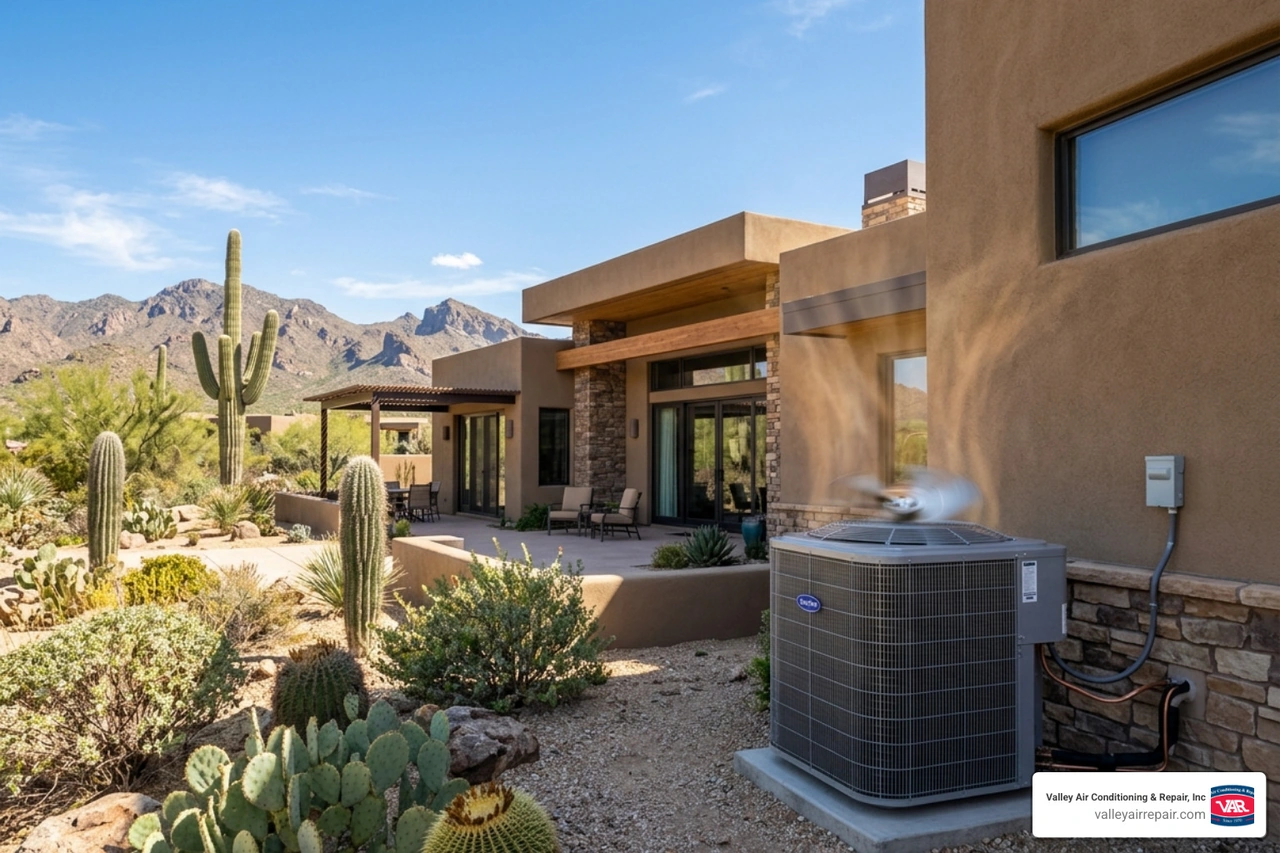
When constant ac running signals a problem vs normal desert operation is one of the most common questions Central Valley homeowners face every summer — and the answer is not always obvious. In Modesto and surrounding areas, temperatures regularly climb past 100°F for weeks at a time, pushing air conditioning systems to their absolute limits. That constant hum from your AC might be completely normal. Or it could be your system quietly burning itself out while your energy bill quietly climbs.
Here is the short answer most homeowners need right away:
Your AC running constantly is NORMAL if:
Your AC running constantly is a PROBLEM if:
| Condition | Normal Operation | Problem Signal |
|---|---|---|
| Outdoor temp above 100°F | Runs 12-16 hours/day | Never reaches setpoint |
| Outdoor temp below 90°F | Cycles on and off regularly | Runs without stopping |
| Airflow from vents | Strong and cold | Weak, warm, or inconsistent |
| Indoor temperature | Holds within 1-2°F of setpoint | Keeps climbing despite runtime |
| Energy bill | Elevated but stable | Unexpectedly high or rising |
The Central Valley's brutal summer heat means your AC genuinely does work harder here than almost anywhere else in the country. Phoenix and Las Vegas systems log over 3,000 hours of runtime per year — and Modesto is no different. So before you panic, it helps to know exactly what "normal" looks like in this climate, and where the line is between a hard-working system and one that needs attention.
The sections below walk you through how to tell the difference, what to check yourself, and when to call in a professional.

In May 2026, as we look at the cooling trends across the Valley, it is clear that our geography dictates a different set of rules for HVAC systems. In milder climates like Minneapolis, an AC might run for 800 hours a year. Here in Fresno or Clovis, your system is likely logging 3,000 to 3,500+ hours annually. This massive difference in workload means that proper HVAC maintenance for desert climate is not just a luxury; it is a survival requirement for your equipment.
When the mercury hits 115°F, your AC unit is operating at its thermal limit. At these extremes, the system may run for 14 to 18 hours a day. If the unit is successfully holding your home at 78°F while it is 110°F outside, it is doing exactly what it was designed to do. However, if that runtime doesn't result in a comfortable home, you are likely facing a mechanical failure or an efficiency bottleneck.
Most residential air conditioners are designed to create a "Delta T" (temperature difference) of about 20 degrees between the outdoor air and the indoor air. When it is 110°F in Turlock, your AC is fighting a constant battle against "heat gain"—the process of heat seeping through your walls, windows, and attic.
If your insulation is thin or your windows are older, your home may reach a state of thermal equilibrium where the AC can only keep the house at 80°F. In this specific scenario, the constant running is "normal" for the conditions of the house, even if it’s frustrating. This highlights why HVAC system maintenance is vital; a well-tuned system can squeeze every bit of cooling capacity out of the equipment to fight that outdoor heat.
If you have recently upgraded your system, you might notice it runs almost all day, even when it isn't 110°F outside. Don't worry—this is often by design. Modern variable-speed compressors don't just blast on and off like older "single-stage" units. Instead, they ramp down to a low-power mode, running for longer cycles to maintain a perfectly steady temperature and better manage indoor humidity.
During a professional AC system inspection, a technician can verify if your long runtimes are the result of this high-efficiency technology or a sign of a struggling motor.
The most obvious sign that when constant ac running signals a problem vs normal desert operation is a setpoint failure. If your thermostat is set to 75°F, but the display shows 82°F and the AC has been running since breakfast, something is wrong. Another red flag is rising indoor humidity. Even in our dry climate, a properly functioning AC should remove moisture; if your home feels "sticky" or "muggy," the system isn't completing the refrigeration cycle effectively.
If you find yourself asking why is my ac running but not cooling, you should immediately check your indoor unit for ice. Frozen evaporator coils are a classic sign of trouble.
Airflow is the lifeblood of your cooling system. When airflow is restricted, the system has to run longer to move the same amount of "cool" into your living space. The most common culprit? A dirty filter. We recommend AC filter replacement every 30 to 45 days during the peak Central Valley summer.
Beyond filters, listen to your vents. If you hear a high-pitched sound, you might be wondering why is my ac making a whistling sound. This usually indicates a return air blockage or a leak in your ductwork, both of which force the AC to run non-stop to compensate for the lost air pressure.
Refrigerant does not get "used up" like gasoline in a car. It stays in a closed loop. If your levels are low, you have a leak. Low refrigerant reduces the system's ability to absorb heat, leading to cycles that never end.
To understand ac refrigerant leaks and solutions, you should listen for specific cues. If you are asking why is my ac making a hissing sound, that is often the sound of high-pressure refrigerant escaping a tiny hole in the coils. This mechanical failure will cause the compressor to run indefinitely as it tries—and fails—to reach your desired temperature.
The Central Valley environment is uniquely hostile to mechanical equipment. We deal with "caliche" dust—a fine, alkaline silt that acts like a blanket on your outdoor condenser coils. When these fins are coated in dust, they cannot release heat into the outside air. A 15% reduction in coil efficiency due to dust can lead to a 10-15% jump in your cooling runtime. This is why preventative AC maintenance often pays for itself in energy savings alone.
A single major dust event or "haboob" can deposit more dirt on your AC than a year of normal wind. This accumulation chokes off airflow at the condenser, causing head pressures to spike and the compressor to work much harder. For those in the northern part of the Valley, our AC service Fresno CA complete guide emphasizes the need to hose down your outdoor unit (gently!) after any significant wind storm to keep those runtimes in check.
The relentless California sun doesn't just heat your home; it destroys the components sitting outside. UV radiation degrades the foam insulation on your refrigerant lines, causing them to crack and peel within just a few years. More dangerously, the heat inside the electrical cabinet of your AC can exceed 140°F, leading to capacitor failure.
When a capacitor begins to fail, the motor may struggle to start or stay running efficiently. If you are curious about what's causing your ac compressor to fail, the answer is often a combination of these environmental stressors and the sheer number of hours the unit is forced to run.
Before calling for a professional AC diagnostic service, there are a few things you can check yourself. Start with the thermostat. Ensure it isn't located near a heat source, like a sunny window or a kitchen appliance, which could be "tricking" it into thinking the house is warmer than it actually is.
If your unit isn't running at all, or the indoor fan is silent, you’ll need to know what to do when ac fan stops working—often, checking your circuit breaker is the first step.
One of the most effective DIY tests is checking the "Delta T." Take a simple thermometer and measure the temperature of the air being sucked into your return vent. Then, measure the temperature of the air coming out of the supply vent closest to the AC unit.
In a healthy system, the air coming out should be 16 to 22 degrees cooler than the air going in. If the difference is only 5 or 10 degrees, your AC will run constantly because it simply isn't "cold enough" to do the job. If you notice the ac condenser fan not spinning during this test, turn the system off immediately to prevent compressor damage.
Walk outside and look at your condenser. Does it have at least two to three feet of clearance on all sides? We often see homeowners try to hide their AC behind bushes or fences, but this traps hot air around the unit, forcing it to run longer. Also, check for air conditioner leaks around the base of the unit. While some condensation (water) is normal, oily residue can indicate a refrigerant leak that requires professional repair.
Yes, during July and August when temperatures exceed 105°F, it is very common for a properly sized AC to run 12 to 16 hours a day. As long as the system is maintaining your set temperature and the air coming from the vents is cold, it is likely just doing its job.
This usually indicates one of three things: the outdoor heat has exceeded the system's "20-degree" cooling capacity, the unit is undersized for the home, or there is a mechanical issue like a dirty coil or low refrigerant. If this happens on a day that is only 90°F, you definitely have a mechanical problem.
Absolutely. A clogged filter acts like a wall, preventing your AC from pulling enough air across the cooling coils. This makes the system work twice as hard to move half as much cool air, leading to non-stop operation and potential system freeze-ups.
At Valley Air Conditioning & Repair, Inc., we have been serving the Central Valley since 1970. We understand that our local climate puts a unique strain on your home's comfort system. Whether you are in Fresno, Modesto, or Madera, knowing when constant ac running signals a problem vs normal desert operation can save you from unnecessary stress and high utility costs.
Our customer-first philosophy means we are here to help you distinguish between a hard-working unit and a failing one. If your DIY checks suggest your system is struggling, don't wait for a total breakdown in the middle of a heatwave. Trust our decades of local expertise to keep your home cool and your system running efficiently all summer long.
For expert assistance with your system, visit our Air Conditioning service page or give us a call today.

As a business with many AC units, it is essential to have a responsive AC company. Valley Air Conditioning understands our needs. They are always responsive and our AC is up and running very quickly.
I had them do an AC check on the home I was buying, they were honest and quick. I hired them to do the summer and Fall maintenance for $149. Happy with this company!
100% recommend. I called, same day they came out and gave me estimate. Conley was honest and didn't try to recommend/sell us anything we didn't need. When I called him with questions before making a decision, he happily answered and was not annoyed by me contacting him. Conley and VAR
This is a group of good people. Very professional and knowledgeable. They take the time to listen and find the best solution that fits best for any situation. There's no way you can go wrong in choosing VAR.
We have used Valley Air for over fifteen years. The last two years ,Matt came to our house to service twice a year. Always on time, so polite and so professional. This is a very honest company and you can always depend on them and trust them. The office always treats everyone cheerfully and always want to do what you need done very fast YOU CAN COUNT ON THIS Company