.webp)


How Your Furnace Flame Sensor Dictates Safe Operation
If your heating system fires up only to shut down seconds later, a dirty flame sensor is likely to blame. See why this tiny rod triggers a strict safety lockout.

July in the Central Valley is already here, and at Valley Air Conditioning & Repair, Inc., our team fields dozens of calls every week from homeowners asking exactly why your AC struggles to reach 72 degrees when it is 108 outside. It is a stressful moment for any homeowner. You walk past the thermostat at 4:00 p.m., notice the indoor temperature has crept up to 78 or 80 degrees, and hear the outdoor unit roaring away without a pause. The immediate reaction is usually panic. You start wondering if the compressor is failing, if you have a massive refrigerant leak, and whether you need to call for an emergency repair before the house becomes completely unlivable.
To secure professional help right away, explore our air conditioning services to see how we can assist.
Here is the thing: what you are experiencing is often entirely normal. Standard residential cooling systems are simply not designed to act like commercial refrigeration units. They have specific engineering limits based on the laws of thermodynamics. When an extreme 108°F outdoor peak hits your neighborhood, the sheer volume of radiant heat baking your roof, walls, and windows begins to outpace the mechanical capacity of your equipment. The heat transfers into your living space faster than the blower motor and evaporator coil can remove it.
During these intense July heat spikes, where afternoon temperatures sustain extreme levels for hours on end, your home absorbs a massive thermal load. The attic temperature can easily exceed 140 degrees, pressing down on your ceiling insulation. Your windows, even if they are double-paned, allow solar radiation to warm your floors and furniture. Your air conditioner is fighting a battle on multiple fronts. Understanding how this battle works is the first step to staying comfortable and avoiding unnecessary panic when the weather turns brutal.
To understand why your system cannot magically produce a 72-degree living room during a severe heatwave, you have to look at how residential HVAC equipment is actually engineered. The core concept you need to know is called Delta T, or the temperature differential. In the HVAC industry, this refers to the difference in temperature between the air entering your system and the air leaving it.
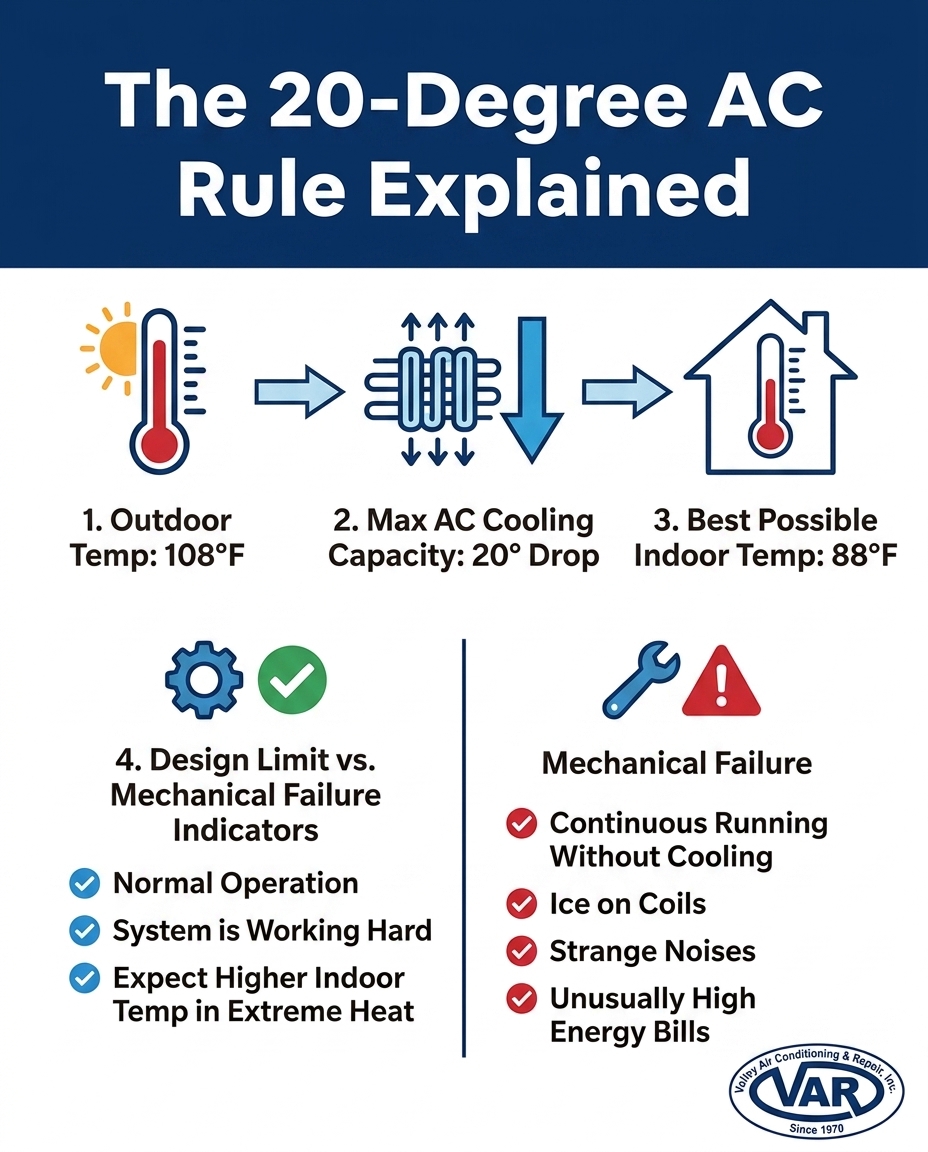
Standard residential units are engineered for a maximum 20-degree temperature differential between the indoor return air and the outdoor air. This means that under optimal conditions, the absolute best your system can do is cool the house to about 20 degrees lower than the temperature outside. If the outdoor thermometer reads 108 degrees, an indoor temperature of 88 degrees means your air conditioner is actually operating at 100% of its designed capacity. Reaching 72 degrees indoors is mechanically impossible when outside temperatures soar past 92 degrees. Our technicians at Valley Air Conditioning & Repair, Inc. believe in an education-first approach—explaining the math behind the system so you understand its limits instead of assuming it is fundamentally broken.
If you suspect your system is not even hitting this standard benchmark, scheduling an AC diagnostic service is the best way to get a clear picture of its performance.
It helps to understand where the air comes from. Your air conditioner does not pull 108-degree air from your backyard and try to cool it. It pulls the existing air from inside your house through the return vents, passes it over the cold evaporator coil, and pushes it back out. As the heat builds up outside, it continuously bleeds through your home's exterior envelope, raising the temperature of that indoor air before the system can cycle it again.
Another major factor limiting your system's ability to drop the temperature is humidity. Air conditioners perform two distinct jobs simultaneously: sensible cooling and latent cooling. Sensible cooling is the actual lowering of the air temperature—the number you see dropping on your thermostat. Latent cooling is the removal of moisture from the air.
When warm air passes over the freezing cold evaporator coil, condensation forms, much like water droplets gathering on the outside of a cold glass of iced tea on a summer day. This dehumidification process takes up a massive amount of the air conditioner's overall energy and capacity. If your home has high humidity levels—perhaps from cooking, showering, or simply the ambient weather—the system has to work incredibly hard just to wring that water out of the air. Until the humidity drops, the sensible temperature will struggle to fall. The system is splitting its power between drying the air and chilling the air, which further explains why hitting that 72-degree target is so difficult under heavy loads.
Once homeowners understand the 20-degree rule, the next logical question is usually, "Why not just install a much bigger air conditioner that can handle the extreme heat?" It seems like a simple fix: if the current unit is not strong enough to hit 72 degrees on a 108-degree afternoon, a unit with double the capacity should do the trick. Unfortunately, HVAC engineering does not work that way, and installing an oversized unit creates far more problems than it solves.
The Problem: Homeowners assume that cooling capacity should be based on the absolute worst-case weather scenario. They want a system sized specifically to defeat the most brutal Fresno summer heatwaves, rather than one sized for typical daily temperatures.
The Cause: HVAC systems are strictly sized based on complex mathematical formulas known as Manual J load calculations. These calculations take into account your home's square footage, insulation levels, window orientation, and the region's average summer highs. In our years of installing and servicing systems across Fresno, we see firsthand how critical these calculations are for California's Climate Zone 13. State regulations, specifically Title 24 strictures, mandate that HVAC contractors follow these exact sizing guidelines to maximize energy efficiency. Sizing a system for a few weeks of extreme heat anomalies ruins the system's efficiency for the remaining months of the cooling season.
The Solution: Trusting the load calculation and accepting that a properly sized unit will run continuously on the hottest days. If you force an oversized unit into a home, you will experience a phenomenon called "short-cycling." A massive compressor blasts the house with freezing air, satisfying the thermostat in just ten minutes. It then shuts off. Because it ran for such a short time, it never completed the latent cooling phase—meaning it left all the humidity inside the house. Your home will feel cold, clammy, and incredibly uncomfortable. Furthermore, turning a heavy-duty motor on and off dozens of times an hour causes severe wear and tear on the electrical components, leading to premature failure and drastically higher energy bills during normal weather. For a comprehensive evaluation of your current system's sizing and health, professional AC service in Fresno is the most reliable path forward.
One of the most common reasons homeowners panic during a heatwave is the sound of their air conditioner running without a break. When the outdoor unit hums along for four, five, or six hours straight, it is natural to worry that the motor is going to burn itself out. You might be tempted to manually turn the thermostat up just to give the machine a "rest."
When our technicians visit Fresno homes during these brutal July heatwaves, we constantly reassure homeowners that continuous operation during peak heat is completely normal and is not inherently damaging to the equipment. In fact, your air conditioner is designed to run in long, steady cycles. The most stressful moment for any electric motor—including your AC compressor—is the startup phase. When the system first kicks on, it draws three to five times more electricity to overcome inertia and get the internal components moving. This massive draw of starting amps generates significant heat and stress on the capacitors and windings.
Think of it like driving a car. Highway driving, where you cruise at a steady 65 miles per hour for hours on end, is highly efficient and relatively gentle on the engine and transmission. Stop-and-go city traffic, where you are constantly accelerating and braking, burns more gas and wears out your brake pads and drivetrain much faster. An air conditioner that runs continuously on a 108°F outdoor peak is doing exactly what it was designed to do: cruising on the highway.
By running continuously, the system maximizes its latent cooling (moisture removal) capabilities and maintains a steady airflow throughout the ductwork. Turning it off to "rest" only allows the thermal mass of your home—the walls, floors, and furniture—to heat up. When you finally turn the system back on, it has to work twice as hard to remove that deeply embedded heat. If you are curious about the specific mechanical toll this takes over time, understanding how 105-degree days strain AC compressors can help you make informed decisions about maintenance.
Even if your system is functioning perfectly within its design limits, sitting in an 80-degree house is not pleasant. Fortunately, there are several non-mechanical, proactive steps you can take to cool the human body and reduce the thermal load on your home interior when the AC is maxed out during Fresno summer heatwaves. By managing the heat sources inside your home, you give your equipment a fighting chance.
• Close blinds and thermal curtains: Radiant heat from direct sunlight is your air conditioner's biggest enemy. During the hottest parts of the day, keep all window coverings tightly closed, especially on south- and west-facing windows. Blocking the sun before it hits your floors and furniture significantly reduces the sensible heat the AC has to remove.
• Utilize ceiling fans for the wind-chill effect: Ceiling fans do not lower the temperature of the room; they cool the people in it. The moving air creates a wind-chill effect on your skin, evaporating moisture and making you feel up to four degrees cooler. This allows you to tolerate a higher indoor ambient temperature without discomfort. Just remember to turn them off when you leave the room to save electricity.
• Delay using heat-generating appliances: Your oven, stovetop, dishwasher, and clothes dryer generate massive amounts of heat and humidity. Running them at 3:00 p.m. forces your struggling AC to work even harder. Shift cooking, laundry, and dishwashing tasks to the early morning or late evening hours when the outdoor temperatures are more forgiving.
• Pre-cool your home early in the day: Take advantage of the cooler morning air. Set your thermostat a few degrees lower than normal (around 68 or 70 degrees) from 6:00 a.m. to 11:00 a.m. This "supercools" the thermal mass of your home. When the afternoon heat hits and you raise the thermostat back to 75 or 78, your house will have a buffer of cold energy stored in the walls and furniture, delaying the indoor temperature spike.
Implementing these habits makes a massive difference in your daily comfort. Getting your equipment checked before the severe weather arrives is equally critical; proactive pre-season AC preparation ensures your system is clean, charged, and ready for the heavy lifting.
The most difficult part of a severe heatwave is knowing when to trust the system's design limits and when to actually pick up the phone and call a professional. As Fresno's trusted HVAC experts, we advocate for a transparent approach: advising against panic-buying emergency repairs during the peak afternoon heat if the system is simply doing its best against extreme odds. However, true mechanical failures do happen, and knowing the difference saves you time, money, and stress.
The easiest way to determine the health of your system is to evaluate the air coming out of your supply vents and monitor how the system behaves after the sun goes down.
• Vent Air Temperature — Operating at Design Limit (Normal): Air feels distinctly cool to the touch (usually 15-20 degrees colder than the room temperature), even if the room itself is warm. — True Mechanical Failure (Needs Repair): Air feels lukewarm, room temperature, or completely warm. This indicates a compressor failure or severe refrigerant leak.
• Nighttime Recovery — Operating at Design Limit (Normal): As outdoor temperatures drop below 90°F in the evening, the system successfully catches up and cools the house back down to your 72-degree target. — True Mechanical Failure (Needs Repair): Even at 2:00 a.m. when it is 75°F outside, the system runs continuously and the house remains uncomfortably warm.
• Airflow Strength — Operating at Design Limit (Normal): Air pushes out of the vents with normal, strong pressure, circulating well throughout the room. — True Mechanical Failure (Needs Repair): Air barely trickles out of the vents, often accompanied by a frozen evaporator coil. (Check your air filter first—a dirty filter mimics this failure).
• System Noises — Operating at Design Limit (Normal): A steady, consistent hum from the outdoor compressor and indoor blower motor. — True Mechanical Failure (Needs Repair): Loud grinding, screeching, harsh buzzing, or a clicking sound that repeats without the fan starting.
If your system is blowing cold air but simply cannot overcome the 20-degree temperature differential during the hottest hours of the day, it is functioning normally. Keep the curtains closed, turn on a fan, and wait for the evening. If, however, the air is warm, the airflow is choked off, or the system fails to recover overnight, you are dealing with a mechanical breakdown that requires professional diagnostics. A restricted airflow issue caused by a severely clogged air filter is one of the most common, preventable problems that perfectly mimics a dying compressor. Always check your filter before assuming the worst.
What is the 20 degree rule for AC?
The 20-degree rule states that standard residential air conditioners are engineered to cool the indoor air by a maximum of 20 degrees compared to the outdoor temperature. If it is 100 degrees outside, an indoor temperature of 80 degrees means the system is operating exactly as designed. Pushing the equipment beyond this limit is mechanically impossible without specialized commercial refrigeration technology.
Should my AC run constantly in 100 degree weather?
Yes, continuous operation during extreme heat is completely normal and expected. Running constantly is actually easier on the system's electrical components than frequently turning on and off. As long as the air coming from the vents is cool and the system catches up when the sun goes down, constant running is not a cause for alarm.
How can I help my AC in extreme heat?
You can support your system by reducing the heat load inside your home. Close all blinds and thermal curtains to block radiant sunlight, avoid using heat-generating appliances like ovens and dryers during the afternoon, and use ceiling fans to keep yourself comfortable. Pre-cooling your home in the early morning also provides a thermal buffer against the afternoon heat.
Will setting the thermostat lower make the AC cool faster?
No, setting the thermostat to 65 degrees will not cool your house any faster than setting it to 72 degrees. Air conditioners operate at a single, consistent speed; they do not blow colder air based on how low the thermostat is set. Dropping the temperature setting drastically only forces the system to run endlessly without achieving the impossible target.
How cold should my AC be if it's 100 degrees outside?
Based on standard HVAC design limits, if it is 100 degrees outside, your indoor temperature will likely hover around 80 degrees during the peak heat of the day. The air coming directly out of your vents should feel crisp and cool—typically about 15 to 20 degrees colder than the ambient room temperature—but the overall house will struggle to drop below that 20-degree differential threshold until the evening.
Dealing with a sweltering house is frustrating, but understanding why your AC struggles to reach 72 degrees when it is 108 outside puts you in control. By recognizing the 20-degree design rule, you can stop worrying that your system is broken and start using practical strategies to stay cool. If your system still cannot catch up after the sun goes down, it is time to bring in a professional to restore your comfort.

As a business with many AC units, it is essential to have a responsive AC company. Valley Air Conditioning understands our needs. They are always responsive and our AC is up and running very quickly.
I had them do an AC check on the home I was buying, they were honest and quick. I hired them to do the summer and Fall maintenance for $149. Happy with this company!
100% recommend. I called, same day they came out and gave me estimate. Conley was honest and didn't try to recommend/sell us anything we didn't need. When I called him with questions before making a decision, he happily answered and was not annoyed by me contacting him. Conley and VAR
This is a group of good people. Very professional and knowledgeable. They take the time to listen and find the best solution that fits best for any situation. There's no way you can go wrong in choosing VAR.
We have used Valley Air for over fifteen years. The last two years ,Matt came to our house to service twice a year. Always on time, so polite and so professional. This is a very honest company and you can always depend on them and trust them. The office always treats everyone cheerfully and always want to do what you need done very fast YOU CAN COUNT ON THIS Company