.webp)


Guide
Why Phoenix Heat, Dust Storms, and Monsoons Push Your AC to the Limit
How Desert Dust Heat and Monsoons Affect Your AC System
#
Understanding how desert dust, heat, and monsoons affect your AC system starts with one simple truth: your air conditioner was not designed to face all three threats at once — but in the desert Southwest and California's Central Valley, that is exactly what it deals with every summer.
Here is a quick breakdown of each threat and what it does to your system:
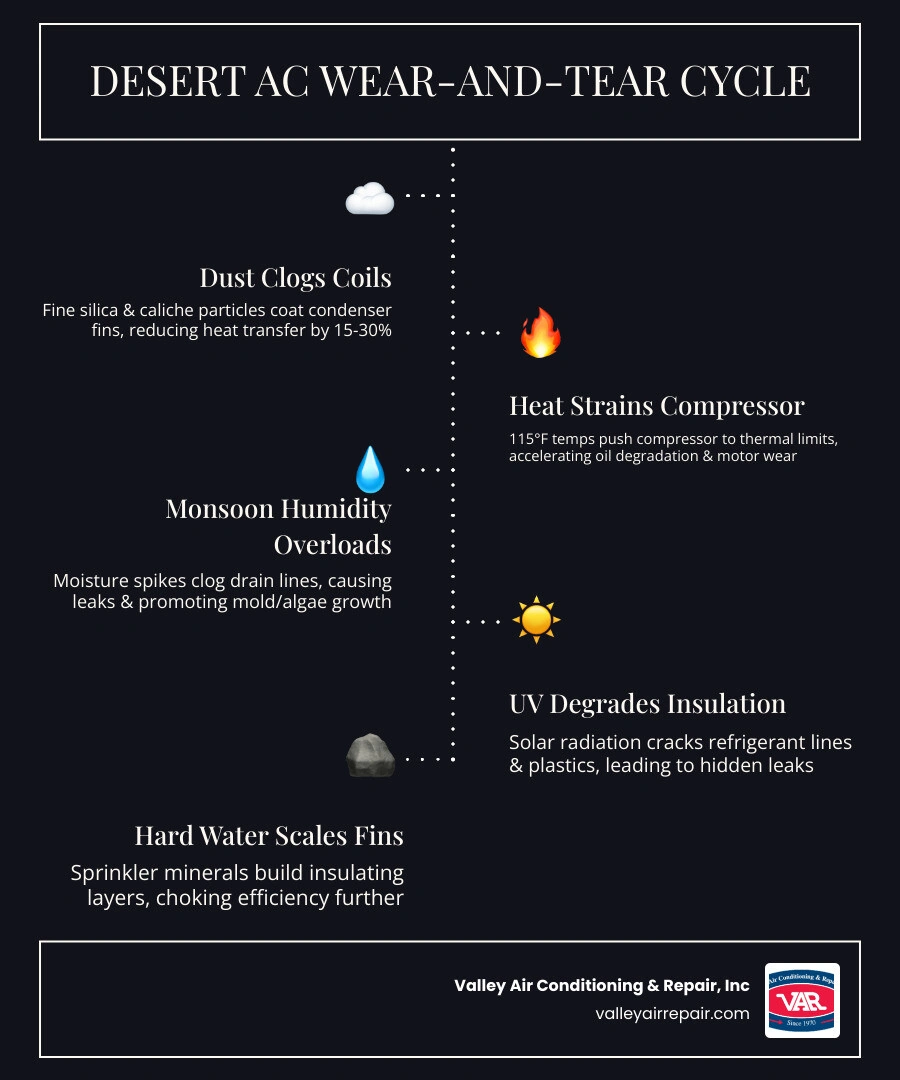
- Desert dust (including fine silica and caliche particles) coats condenser coils and clogs filters, acting like an insulating blanket that blocks heat transfer and can reduce system efficiency by 15–30%
- Extreme heat forces your compressor to run near its thermal limit for months, accelerating wear on capacitors, motors, and refrigerant oil
- Monsoon humidity spikes the moisture load your AC must remove from indoor air, strains condensate drain lines, and creates conditions for mold and algae growth inside your system
- UV radiation silently degrades refrigerant line insulation and plastic components, often going unnoticed until a failure occurs
- Hard water overspray from sprinkler systems deposits mineral scale on condenser fins, adding another layer of insulation that chokes efficiency
Together, these forces can compress a well-built AC system's lifespan from 15+ years down to as few as 6–9 years if left unmanaged. The good news is that knowing what you are up against is the first step to protecting your investment.
Living in areas like Fresno, Clovis, or Madera during May 2026, we’ve all seen those massive walls of dust rolling across the Valley. While they look like something out of a sci-fi movie, they are a mechanical nightmare for your HVAC unit. The problem isn't just "dirt"; it’s the specific composition of desert dust.
Unlike organic dust found in more humid climates, our dust is primarily composed of caliche (calcium carbonate) and abrasive silica particles. When a haboob or windstorm kicks up, these fine mineral fragments don't just sit on the surface of your outdoor unit; they bond to the aluminum fins of your condenser coil.
This creates what we call an "efficiency tax." Think of your condenser coil like a radiator in a car. Its job is to release the heat collected from inside your home into the outdoor air. When it's coated in a layer of caliche dust, that heat can’t escape. A thin layer of dust can reduce heat transfer efficiency by 5–10%, but a full season of accumulation without proper HVAC maintenance for desert climate can skyrocket that loss to 30%.
When the heat can't escape, the system pressure rises, forcing the compressor to work harder and run longer. If you’ve ever wondered why is my AC running but not cooling, the answer is often found in the thick grey "sweater" of dust wrapped around your outdoor unit.
How desert dust heat and monsoons affect your ac system filters
Your air filter is the first line of defense, but during monsoon season, it becomes a victim of its own success. Desert dust storms deposit more particulate matter on your system in a single hour than a month of normal wind exposure.
In a standard climate, you might get away with changing your filter every three months. In the Central Valley during the summer, that’s a recipe for disaster. When fine dust infiltrates your return vents, it quickly chokes the filter, leading to severe airflow restriction.
This restriction does two things:
- It starves the evaporator coil of air, which can cause the coil to freeze over.
- It puts immense strain on the blower motor. The motor has to spin faster and work harder to pull air through a clogged filter, which leads to overheating and premature failure.
During the peak of the dust season, we recommend a two-week replacement cycle. It might seem frequent, but compared to the strain of dirty air filters on your HVAC system, it’s the cheapest insurance policy you can buy.
How desert dust heat and monsoons affect your ac system lifespan
In places like Minneapolis, an AC system might run for 800 hours a year. In our neck of the woods, a typical system runs between 3,000 and 3,500+ hours per year. We aren't just using our AC; we are marathon-running it in a furnace.
This high runtime, combined with the abrasive nature of silica dust, creates a "math issue" for your equipment. Mechanical parts have a finite number of cycles before they fatigue. When you add the friction of dust particles entering motor bearings and the constant thermal expansion and contraction from 110-degree days, the lifespan of the unit naturally compresses.
Without preventative AC maintenance, a system in our climate may only last 6 to 9 years. However, with consistent care, that same unit can often reach 12 to 18 years. If you are currently asking is it worth fixing an old AC unit in the desert, the answer usually depends on how well it was shielded from these environmental stressors over its life.
The Impact of Extreme Heat on Critical Components
When the thermometer hits 115°F in the Central Valley, your AC system enters what we call the "thermal red line." At these temperatures, the air outside is so hot that it struggles to absorb the heat coming off the condenser coils.
This environmental pressure causes "compressor head pressure" to spike. The compressor is the heart of your system, and high pressure makes it pump against a literal wall of resistance. This isn't just a performance issue; it’s a chemical one. Extreme heat causes the refrigerant oil to degrade. Once that oil loses its viscosity, the internal parts of the compressor start to grind, leading to a catastrophic "burnout."
Furthermore, extreme heat is the number one killer of capacitors. These small cylindrical components provide the "kick" needed to start your motors. They are sensitive to heat, and when they fail, you’ll often hear a specific sound. If you find yourself asking why is my AC making a buzzing noise, it’s usually a sign that a capacitor has given up the ghost under the summer sun. This is a primary reason why your AC runs constantly in Arizona heat (and our local California heat)—it's struggling to maintain the setpoint against an environment that is actively trying to cook the electronics.
Monsoon Humidity and the Latent Heat Load
Most of the year, our air is bone-dry. But when monsoon moisture rolls in from the south, your AC has to shift its strategy. It moves from handling "sensible heat" (the temperature you see on the thermometer) to "latent heat" (the energy trapped in water vapor).
| Feature | Sensible Heat | Latent Heat (Monsoon) |
|---|---|---|
| What it is | Temperature you can feel | Moisture/Humidity in the air |
| AC Action | Lowers the air temperature | Removes water via condensation |
| System Strain | Standard compressor work | Heavy evaporator & drain work |
| Risk Factor | Overheating | Leaks and mold growth |
When humidity spikes, your evaporator coil (the indoor part) becomes soaking wet as it pulls gallons of water out of the air. This moisture mixes with any fine dust that bypassed your filter, creating a thick, muddy sludge. This sludge is the leading cause of why is my AC leaking water in Fresno.
If the condensate drain line gets clogged with this "monsoon mud," the water has nowhere to go but into your emergency pan or, worse, through your ceiling. High humidity also slows down the cooling process. If your vents are making a strange sound, check our guide on why is my AC making a whistling sound, as moisture buildup can actually change the way air moves through your coils.
Protecting Your System from UV Radiation and Hard Water
We get nearly 300 sunny days a year. While that's great for the solar panels, it’s brutal on your AC’s "soft" parts. UV radiation in the desert can peak at levels that literally disintegrate standard plastic and foam.
The most common victim is your refrigerant line insulation (the black foam "armylaflex" on the pipes). Within 3 to 5 years of direct sun exposure, this foam becomes brittle and falls off. Without it, your refrigerant picks up heat from the sun before it even gets into your house, making the system work 5–10% harder for no reason. If you hear a high-pitched noise, you might be dealing with a leak caused by vibration on an uninsulated line; see why is my AC making a hissing sound for more details.
Then there is the "Hard Water Hazard." Our water in the Valley is notoriously hard, often containing 16–28 grains of minerals per gallon. If your landscape sprinklers are hitting your AC unit, you are essentially "painting" your coils with liquid rock. As the water evaporates, it leaves behind calcium and magnesium scale that is nearly impossible to remove with a standard hose. This scale acts as a permanent insulator, choking your system's efficiency year-round. This is why residential HVAC maintenance repair is so vital—we use specialized, non-acidic cleaners to dissolve that scale without eating the aluminum fins.
Essential Post-Storm Maintenance and Protection Strategies
After a major dust storm or monsoon event, don't just wait for the next one. Taking 15 minutes to inspect your unit can save you a service call later.
- The "Inside-Out" Rinse: Once the dust has settled and you’ve turned off the power to the unit, use a garden hose to gently rinse the outdoor condenser. The trick is to spray from the inside out (if possible) or at a downward angle to wash the dust away rather than pushing it deeper into the fins.
- Filter Check: Immediately replace your air filter after a haboob. Even if you just changed it last week, a single storm can load it to capacity.
- Surge Protection: Monsoons bring lightning. A whole-home surge protector or a dedicated AC surge device can protect your expensive control boards from the "dirty power" and spikes common during summer storms.
- Listen for Changes: If your system sounds different after a storm, don't ignore it. Check out why is my AC suddenly making loud noises to identify if it's a simple debris issue or a failing fan motor.
- Duct Sealing: Dust in your home after a storm often means your ductwork has leaks. When filters clog, the system pulls harder, often sucking in dirty attic air through gaps in the ducts.
For a deeper dive into keeping your system peak-ready, our AC service Fresno complete guide covers everything from seasonal prep to emergency troubleshooting.
Frequently Asked Questions about Desert AC Care
How often should I change my air filter during a heavy dust season?
During the peak of the dust and monsoon season (typically June through September), you should check your filter every 2 weeks. If you live near an open field or construction site, you may need to replace it that often. For the rest of the year, once a month is usually sufficient for Central Valley homes.
Can monsoon moisture cause my AC to leak inside the house?
Yes. Increased humidity means your AC is pulling much more water out of the air. If your drain line has a partial blockage from dust or algae, the extra volume of water during a monsoon will cause it to overflow. We recommend flushing your drain lines with a bit of vinegar or a professional clearing service before the humidity spikes.
What are the signs that dust has damaged my outdoor unit?
The most common signs are a noticeable increase in your monthly energy bill, the AC running for longer periods without reaching the set temperature, and a "thick" look to the metal fins on your outdoor unit. If you see a grey or brown tint to the metal, it's time for a professional cleaning.
Conclusion
At Valley Air Conditioning & Repair, Inc., we’ve been serving "the Valley" since 1970. We know that how desert dust, heat, and monsoons affect your AC system is unique to our geography. Our customer-first philosophy means we don't just fix parts; we help you protect your home's most expensive appliance from the elements.
Whether you are in Fresno, Clovis, Sanger, or any of our surrounding communities, don't let the desert eat your air conditioner. Regular AC maintenance Fresno CA is the difference between a system that fails in 7 years and one that keeps you cool for nearly 20. Give us a call today, and let’s make sure your system is ready for whatever the next monsoon brings!
Recent Posts
Customer Testimonials

As a business with many AC units, it is essential to have a responsive AC company. Valley Air Conditioning understands our needs. They are always responsive and our AC is up and running very quickly.
I had them do an AC check on the home I was buying, they were honest and quick. I hired them to do the summer and Fall maintenance for $149. Happy with this company!
100% recommend. I called, same day they came out and gave me estimate. Conley was honest and didn't try to recommend/sell us anything we didn't need. When I called him with questions before making a decision, he happily answered and was not annoyed by me contacting him. Conley and VAR
This is a group of good people. Very professional and knowledgeable. They take the time to listen and find the best solution that fits best for any situation. There's no way you can go wrong in choosing VAR.
We have used Valley Air for over fifteen years. The last two years ,Matt came to our house to service twice a year. Always on time, so polite and so professional. This is a very honest company and you can always depend on them and trust them. The office always treats everyone cheerfully and always want to do what you need done very fast YOU CAN COUNT ON THIS Company
Blogs
Stay updated with our latest blog posts.