


.webp)


Why Is My AC Blowing Warm Air? Fall HVAC Troubleshooting & Startup Smells
Smelling burning dust this fall? Get clear answers with our home maintenance tips and troubleshooting to know when to call a pro for your heating system.
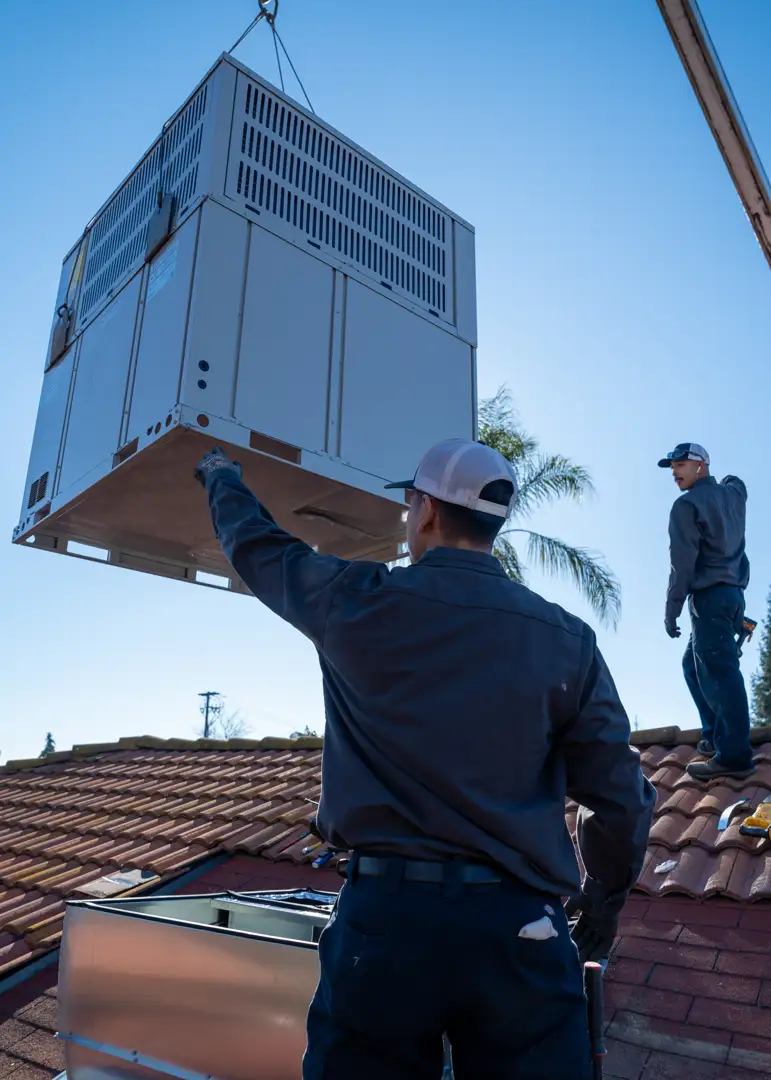
Knowing when should you replace your ac in the desert is one of the most important decisions you'll make as a homeowner in Modesto, Ceres, Turlock, and the surrounding Central Valley. Unlike cooler parts of the country, desert and semi-arid climates push air conditioners far harder — and far longer — than the national averages most people rely on. The result? Your system can wear out years earlier than you'd expect, often failing right when you need it most.
Here's a quick answer if you need it now:
Replace your AC in a desert climate if any of the following apply:
If two or more of these are true at the same time, replacement is almost always the smarter move — especially before summer hits.
The core problem is simple: in places like Modesto and the Central Valley, air conditioners run far longer each year than they do in milder climates. A system that might last 15 to 20 years in a northern state may only last 8 to 12 years under the relentless heat load of a California valley summer. Waiting for a complete breakdown means replacing your AC during peak season — when scheduling is tight and your family is sweltering.
In this guide, we'll walk you through the warning signs, the math behind repair-vs-replace decisions, and how to time your replacement to get the best outcome for your home and your wallet.
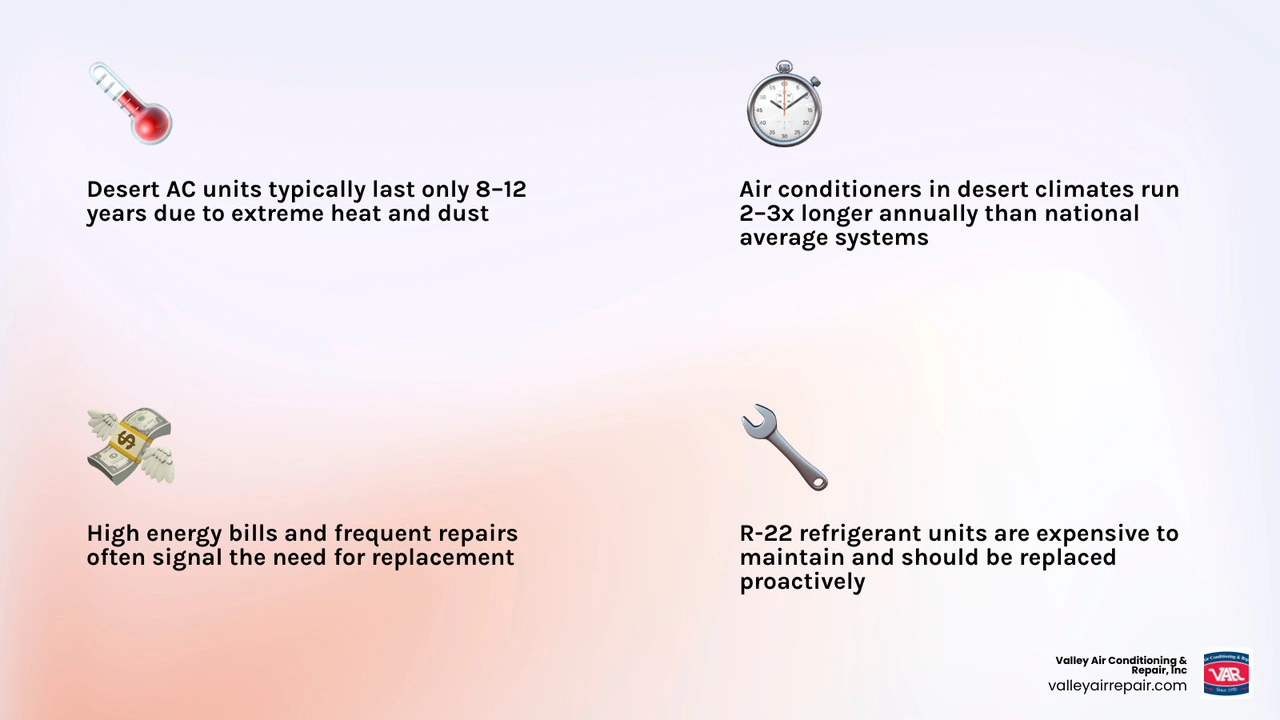
When we talk about the lifespan of an air conditioner, national averages can be incredibly misleading. Across the United States, a well-maintained central air conditioning unit typically lasts between 15 and 20 years. However, if you live in an area with extreme summer heat, high winds, and heavy dust, those numbers simply do not apply.
In the arid and semi-arid regions of California, Arizona, and Nevada, the lifespan of an air conditioning unit drops dramatically. In these brutal environments, a typical system has a realistic lifespan of only 8 to 12 years. By the time a system in Modesto, Ceres, or Turlock reaches its tenth year, it has often logged more operating hours than a northern system would accumulate over a quarter-century.
To understand why this happens, we have to look at three primary environmental stressors:
In mild climates, an air conditioner might only run for 500 to 800 hours per year. In our scorching valley summers, it is not uncommon for an AC unit to run for 2,000 to 2,700 hours annually. This continuous operation places immense mechanical wear and tear on the compressor, fan motors, and electrical components. For a deeper look at how these extreme runtimes compare to other desert regions, you can read about How Long Does an AC Unit Last in the Arizona Desert.
Desert climates are famous for dramatic temperature swings. A day that peaks well over 100°F can drop into the 60s or 70s overnight. This extreme fluctuation causes the metal components in your air conditioner—especially the delicate copper coils—to expand and contract rapidly. Over time, this intense thermal cycling weakens joints, stresses electrical connections, and leads to premature refrigerant leaks.
Our region is prone to dry winds and dust storms. When fine desert dust is pulled into an outdoor condenser unit, it acts like sandpaper on moving parts. Worse, it mixes with the thin layer of oil on the coils, creating a thick, insulating grime that prevents the system from releasing heat. This forces the compressor to work twice as hard to cool your home, driving up utility bills and accelerating system failure. You can learn more about this process in our guide on How Desert Dust Heat and Monsoons Affect Your AC System.

Recognizing the early symptoms of a failing air conditioner is the best way to prevent a mid-July cooling emergency. When a system is reaching the end of its life, it rarely stops working without warning. Instead, it sends out several clear distress signals.
If you are asking yourself when should you replace your ac in the desert, keep a close eye out for these primary warning signs:
Before you approve another quick fix on an aging unit, it is highly recommended to read our analysis on Is It Worth Fixing an Old AC Unit in the Desert to see if a complete upgrade is the more practical financial path.
Aside from the obvious warning signs, there are specific performance red flags that indicate your system is structurally failing.
One of the most common issues is short cycling. This occurs when your air conditioner turns on and off rapidly, running for only a few minutes at a time. In a desert climate, short cycling is highly destructive. It prevents the system from completing a full cooling cycle, which leaves your home feeling humid and clammy. It also places immense electrical strain on the compressor, which can lead to a sudden and catastrophic electrical failure.
Another red flag is continuous operation. If your AC runs non-stop during a 100°F day without ever reaching your thermostat's set temperature, it means the system no longer has the cooling capacity to overcome the outdoor heat load. This is often caused by worn compressor valves, severely clogged coils, or a slow fan motor.
Mechanical decline is often accompanied by unusual sounds and odors. A healthy air conditioner should operate with a steady, predictable hum. If you begin to hear grinding, squealing, rattling, or clicking noises coming from either your indoor air handler or your outdoor condenser, major mechanical components are failing.
If you smell a sharp, burning odor, turn your system off immediately. This is a sign of overheating electrical wiring or a motor winding that is actively burning out, which poses a serious safety hazard.
When faced with a broken air conditioner, it can be incredibly difficult to decide whether to pay for a repair or invest in a brand-new system. To remove the emotion and guesswork from this decision, we recommend using established industry frameworks.
| Factor | Favor Repair | Favor Replacement |
|---|---|---|
| System Age | Under 8 years old | Over 10-12 years old |
| Repair Cost | Less than 30% of replacement | More than 50% of replacement |
| Refrigerant Type | Modern R-410A or R-454B | Obsolete R-22 (Freon) |
| Breakdown History | First major issue in several years | Multiple breakdowns in past 24 months |
| Energy Bills | Stable and predictable | Rising steadily year-over-year |
| Warranty Status | Parts covered under manufacturer warranty | Warranty expired; all costs out-of-pocket |
To help you run the numbers for your own home, you can read our deep dive on the Cost of Repairing Old AC vs Buying a New System.
The 50% rule is a straightforward financial guide. If the estimated cost of a single repair exceeds 50% of the value of a brand-new, comparable air conditioning system, you should always choose replacement. Investing a significant amount of money into a system that is already near the end of its typical desert lifespan is rarely a wise choice, as other aging components are likely to fail shortly after the repair is completed.
Another highly effective mathematical tool is the Age-Repair Multiplier. To use this framework, simply multiply the age of your air conditioning unit (in years) by the cost of the proposed repair.
For example, if you have an 11-year-old system that needs a repair, and you multiply that age by the repair estimate, a high score indicates that you are likely throwing money into a bottomless pit. If the system is only 5 years old and needs a minor fix, the score will be well below the threshold, making a repair the obvious choice.
For more guidance on how to navigate this choice, check out our comprehensive article: Should You Repair or Replace Your AC.
If the math points to a replacement, your next step is choosing a system that is engineered to handle our unique climate. Installing the wrong type of system, or sizing it incorrectly, will lead to high utility bills and a shortened equipment lifespan.
In 2023, the Department of Energy implemented strict new testing standards known as SEER2 (Seasonal Energy Efficiency Ratio 2). These standards reflect how an air conditioner performs under real-world static pressure. In hot, dry regions like the Central Valley, choosing a high SEER2 rating is critical. Upgrading from an older, single-stage system to a modern, variable-speed system can cut your summer cooling bills by up to 30% to 50%.
One of the most common mistakes made during installation is sizing a system based solely on a home's square footage. In a desert climate, this is a recipe for disaster. An oversized system will short-cycle constantly, wearing out its compressor and failing to remove indoor humidity. An undersized system will run continuously, failing to keep your home cool on a 105°F afternoon.
To get the sizing perfect, a professional must perform a Manual J load calculation. This detailed formula evaluates:
For Central Valley homeowners, modern electric heat pumps have become an incredibly popular choice. Unlike older models, today's heat pumps are designed to operate efficiently even when outdoor temperatures soar past 110°F. Because they transfer heat rather than creating it, they offer unmatched efficiency for both summer cooling and winter heating.
To determine if this technology is a good fit for your property, read our regional guides on Best HVAC Setup for the Arizona Desert, Is a Heat Pump Right for Your Desert Home, and the specific Heat Pump Benefits for Arizona Homeowners (which apply perfectly to our warm California valley summers).
The absolute best months to replace your air conditioner are during the spring (March through May) and autumn (October through November). During these mild off-season windows, HVAC companies are not swamped with emergency repair calls. This means you will enjoy much greater scheduling flexibility, shorter wait times for equipment delivery, and a more relaxed, meticulous installation process. Waiting until your system completely fails in July means dealing with long installation backlogs and emergency response times.
Abrasive desert dust is a silent killer of HVAC equipment. It coats the outdoor condenser coils, acting as an insulating blanket that prevents the system from shedding heat. This causes internal operating temperatures and pressures to rise, which places immense strain on the compressor. To protect your new investment, it is vital to change your indoor air filters monthly during the heavy cooling season and schedule professional wash-downs of your outdoor coils at least once a year.
Yes! Thanks to the Inflation Reduction Act and local utility initiatives, there are significant incentives available for homeowners who upgrade to high-efficiency cooling systems. Qualifying heat pumps can earn you substantial federal tax credits under Section 25C. Additionally, local utility companies frequently offer rebate programs for systems that meet specific SEER2 efficiency thresholds, helping to offset the initial cost of your upgrade.
Deciding when should you replace your ac in the desert is all about being proactive. In the harsh summers of Modesto, Ceres, Turlock, Manteca, Ripon, Oakdale, and Riverbank, a reliable air conditioner is not a luxury — it is a safety necessity. Waiting until your system experiences a complete, catastrophic failure in the middle of a triple-digit heatwave can leave your family stranded in an unsafe home while you wait for emergency service.
At Valley Air Conditioning & Repair, Inc., we have spent decades helping our neighbors navigate these tough decisions. Since 1970, our family-owned business has operated on a customer-first philosophy built entirely on trust, honorable intentions, and word-of-mouth growth. We never push for a replacement when a reliable repair will buy you several more years of comfortable, efficient cooling. Our goal is to give you honest, transparent advice so you can make the absolute best choice for your home.
If your air conditioner is struggling to keep up with the valley heat, is over ten years old, or is facing a costly repair, let us help.
To keep your current system running as efficiently as possible, or to have one of our friendly, expert technicians perform a comprehensive system assessment, check out our guide on Proper HVAC Maintenance for Desert Climate and schedule your seasonal tune-up today!

As a business with many AC units, it is essential to have a responsive AC company. Valley Air Conditioning understands our needs. They are always responsive and our AC is up and running very quickly.
I had them do an AC check on the home I was buying, they were honest and quick. I hired them to do the summer and Fall maintenance for $149. Happy with this company!
100% recommend. I called, same day they came out and gave me estimate. Conley was honest and didn't try to recommend/sell us anything we didn't need. When I called him with questions before making a decision, he happily answered and was not annoyed by me contacting him. Conley and VAR
This is a group of good people. Very professional and knowledgeable. They take the time to listen and find the best solution that fits best for any situation. There's no way you can go wrong in choosing VAR.
We have used Valley Air for over fifteen years. The last two years ,Matt came to our house to service twice a year. Always on time, so polite and so professional. This is a very honest company and you can always depend on them and trust them. The office always treats everyone cheerfully and always want to do what you need done very fast YOU CAN COUNT ON THIS Company


